

- Home
- Flanges for Data Center Cooling Systems
Flanges for Data Center Cooling Systems
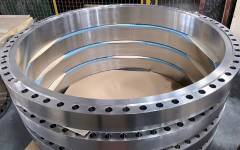
Flanges for data center cooling systems carry the bolted joints on chilled water headers, condenser water circuits, facility water branches and the coolant loops inside a CDU.
Rajendra Industrial Corporation manufactures fittings and flanges in carbon, alloy, stainless and nickel alloys from Umbergaon, Gujarat. As a flange supplier for data center projects, we work to ASME, EN, BS and IS drilling, with an EN 10204 3.1 certificate on every item.
What Flanges Do in a Data Center Cooling System
A flange is the planned disassembly point in a cooling loop. Welded joints stay closed for the life of the building, so the bolted joint is the one a contractor reopens. Data center cooling flanges land at every equipment interface, and on main headers weld neck flanges for chilled water carry the thermal cycling. Flanged joints in chilled water piping appear wherever the loop must open again: chiller nozzles, pump suction and discharge, header tie-ins, strainer and valve bodies, and CRAH coils.
Liquid cooling pipework splits the water three ways. The condenser water system rejects heat outdoors, the facility water system feeds the white space, and the technology cooling system runs inside the coolant distribution unit out to the cold plates. The CDU controls the secondary loop's pressure, temperature, flow, and filtration, holding the supply above the dew point. CDU flange connections sit at the barrier, reopened more than any other joint.
Rack power explains the growing scope. Air cooling handles roughly 30 to 40 kW per rack, and direct-to-chip liquid cooling extends that to roughly 60 to 120 kW. NVIDIA puts the GB300 NVL72 at approximately 135 kW designed, with references up to 142 kW.
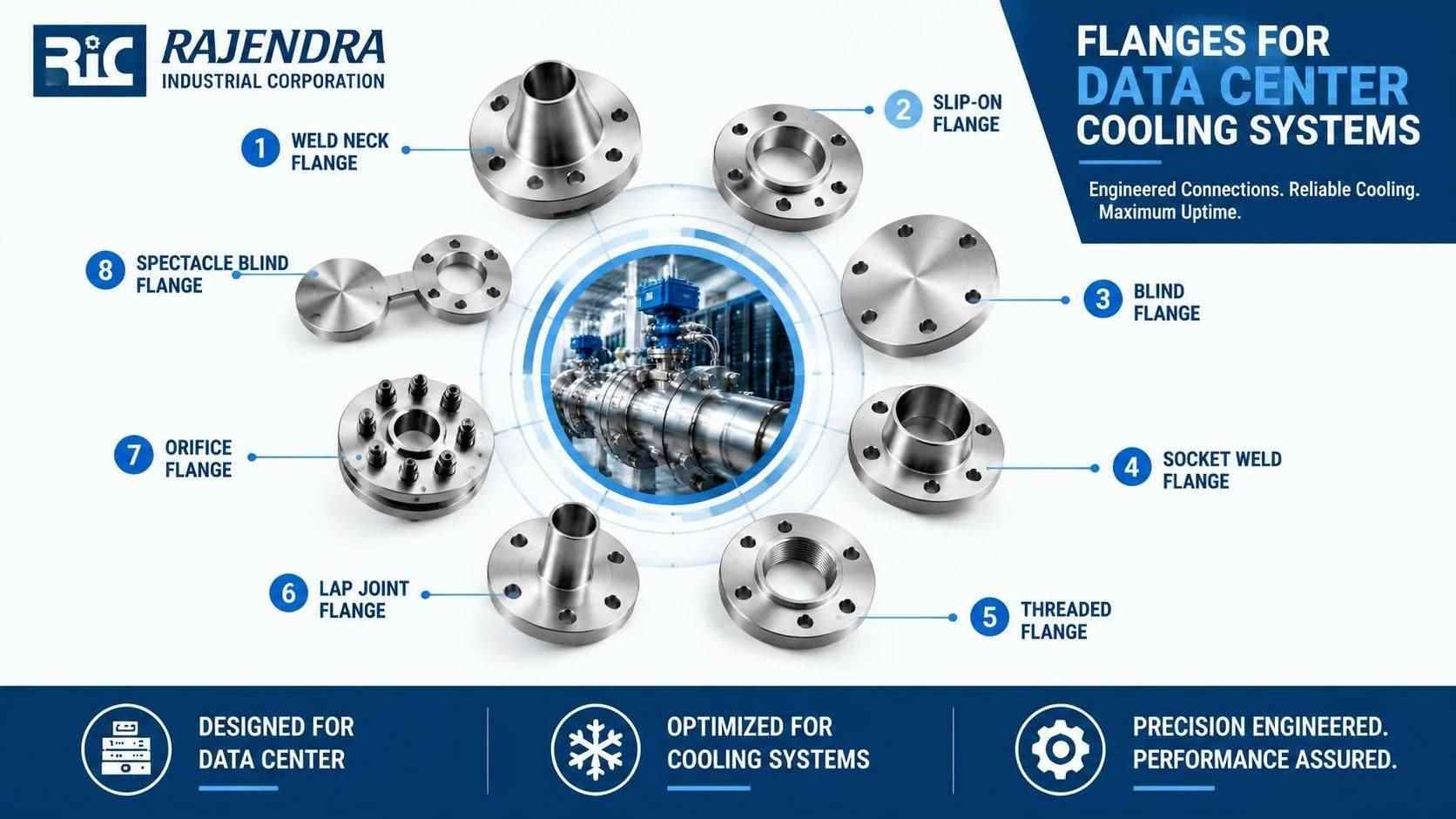
Cooling Systems That Use Flanged Pipe Connections
Six circuits carry flanged connections, each in its own size band and grade.
| Cooling loop | Typical line size | Usual grade |
|---|---|---|
| Chilled water header and risers | 200 to 900 NB | Carbon steel or SS 304L |
| Chilled water branch to CRAH | 50 to 150 NB | SS 304L |
| Condenser water and cooling tower | 150 to 600 NB | SS 316L or duplex |
| Facility water branch to CDU | 50 to 200 NB | SS 316L |
| TCS inside the CDU skid | 25 to 100 NB | SS 316L |
| Make-up water and drain lines | 15 to 50 NB | SS 304L or SS 316L |
Chilled water pipe flanges on the mains run 200 NB to 900 NB, flanged at every valve, branch and nozzle, and above NPS 24 the drilling decision moves away from ASME B16.5. Each CDU branch carries an isolation valve, strainer, balancing valve and nozzle, a stretch that often falls between two contract scopes.
Open-circuit water makes the strongest case for stainless. Make-up water concentrates as it evaporates and chlorides climb, which is why cooling tower pipe flanges move off carbon steel. Air still carries part of the load: roughly 90% of a GB300 NVL72 rack's heat goes to liquid and about 10% leaves by air, keeping CRAH coil flange connections in the design. Inside the TCS, liquid cooling manifold flanges sit at pumps and skid boundaries, while flanges for heat recovery loops need a different gasket.
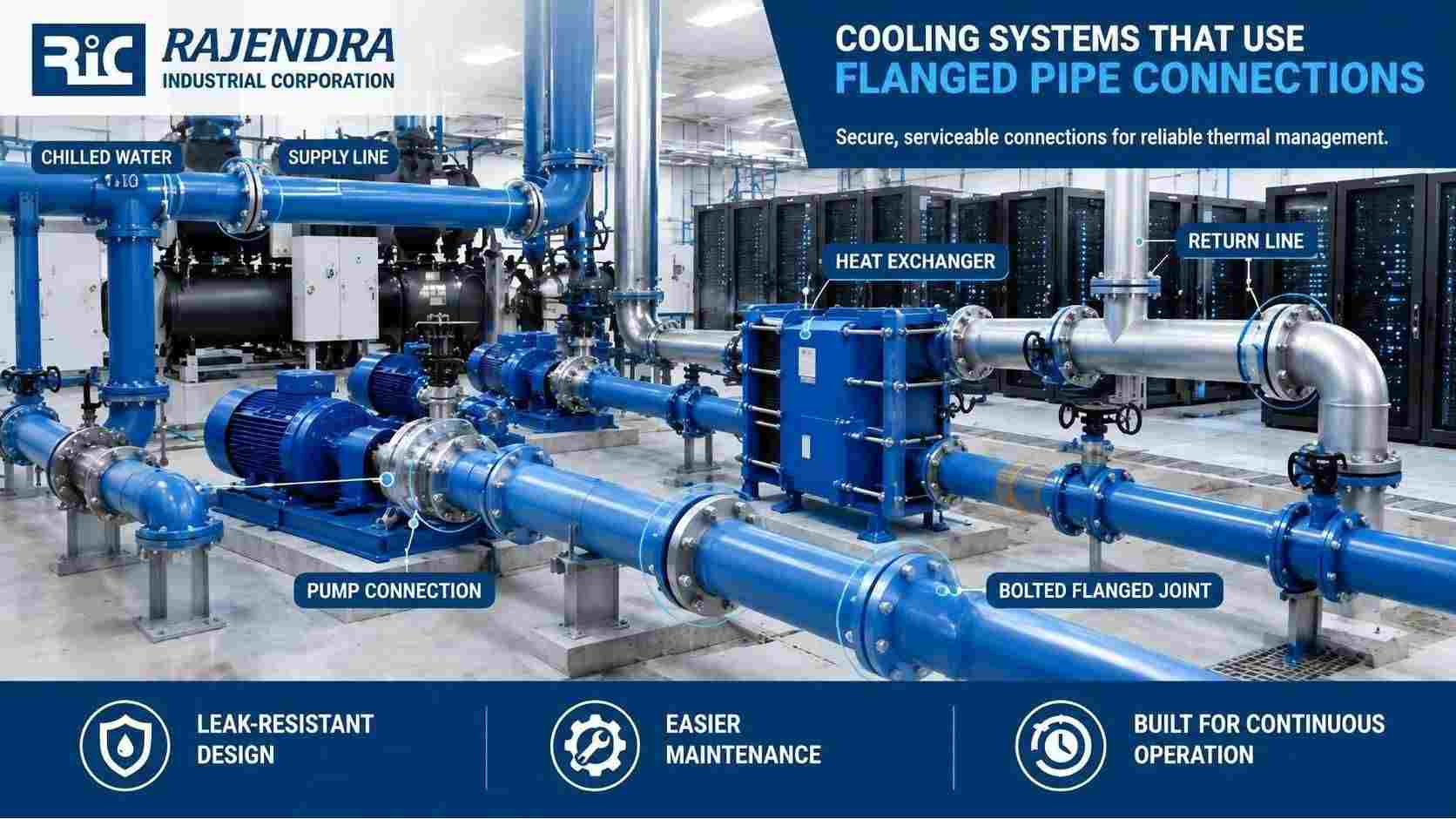
Types of Flanges Used in Data Center Cooling Pipework
Seven types cover a cooling system, plus a flange adaptor for grooved piping where a grooved room meets a flanged nozzle.
| Flange type | Best use in a cooling system | Watch point |
|---|---|---|
| Weld neck | Main headers, pump discharge, cycling | Bore matches pipe schedule |
| Slip-on | Class 150 chilled and condenser water runs | Lower fatigue strength |
| Blind | Capped tap-offs, test and flush points | Thickness rises with size |
| Lap joint with stub end | Long stainless headers, bolt alignment | Only stub end is wetted |
| Socket weld | 15 NB to 80 NB drains and tappings | ASME B16.5 stops at NPS 3 |
| Threaded | Small bore gauge and sensor points | Not for vibration |
| Orifice | Flow metering per CDU or per zone | Supplied as a pair |
| Flange adaptor | Grooved rooms meeting flanged kit | Match coupling rating |
Slip-on flanges for cooling water lines keep fabrication cost down on Class 150 runs, and lap joint flanges and stub ends hold the alloy spend inside the stub end.
One type earns its place for a reason specific to this industry. Open Compute Project guidance recommends preserving pipe paths and tap-off connection points to the facility water system, so liquid cooling can be added later. Blind flanges for capped tap-off points hold that provision open.
Socket weld flanges for small bore lines serve instrument tappings and drains up to 80 NB (NPS 3), which is where ASME B16.5 ends for this type.
Flange Standards Specified on Data Center Projects
Line size selects the standard family for flanges for data center cooling systems.
| Standard | Size range | Where it appears |
|---|---|---|
| ASME B16.5 | NPS 1/2 to NPS 24 | Most cooling pipework, Classes 150 and 300 |
| ASME B16.47 Series A | NPS 26 to NPS 60 | Large campus headers |
| ASME B16.47 Series B | NPS 26 to NPS 60 | Compact large-diameter flanges |
| AWWA C207 | 4 in to 144 in | Carbon steel campus mains |
| AWWA C228 | 2 in to 72 in | Stainless mains, corrosive water |
| EN 1092-1 | DN 10 to DN 4000 | European and GCC drawings; cooling work normally PN 6 to PN 40 |
| IS 6392 | As per table | Indian project specifications |
ASME B16.5 flanges for cooling water cover NPS 1/2 through NPS 24 in ASTM A182 forged materials, and NPS 24 is the ceiling.
ASME B16.47 large diameter flanges take over to NPS 60. Series A descends from MSS SP-44 and Series B from API 605, and the two do not bolt together. Series A runs heavier and thicker at the same size and class, with a larger outside diameter, a larger bolt circle, and fewer but larger bolts. Series B is the compact option: smaller bolt circle, more bolts, smaller diameter. At NPS 30 Class 150 that is 28 holes on Series A against 44 on Series B, which is why the two will never bolt together. Always state the series on the enquiry.
AWWA C228 covers stainless ring and blind flanges from 2 in to 72 in in 304L or 316L. It is the stainless partner to carbon steel AWWA C207, which runs 4 in to 144 in. The ratings line up, but the class letters differ: C207 has Classes B (86 psi), D (175 psi, dropping to 150 psi at 14 in and larger), E (275 psi) and F (300 psi). C228 adds the S prefix and one extra low class: SA (50 psi), SB (86), SD (175/150), SE (275) and SF (300). Class F and SF are the narrowest band, 4 in to 48 in only.
EN 1092-1 covers DN 10 to DN 4000 in PN 2.5 through PN 400. Cooling systems sit in a narrow part of that, usually PN 6 to PN 40. PN and Class never share a joint, because the hole circles differ. Indian projects often pair IS 6392 with BS 4504 drilling.
Flange Materials and Grades for Coolant Service
Water chemistry selects the grade, and chloride level decides it.
| Grade | Specification | Where it suits | Chloride tolerance |
|---|---|---|---|
| SS 304 / 304L | ASTM A182 F304, F304L | Treated closed-loop chilled water | Low |
| SS 316 / 316L | ASTM A182 F316, F316L | Coolant-wetted service, facility water, TCS | Moderate |
| Duplex 2205 | UNS S31803, S32205 | Condenser water, raised chlorides | High |
| Super duplex 2507 | UNS S32750 | Coastal sites, concentrated circuits | Very high |
| Cupro-nickel 90/10 | Copper alloy | Seawater and brackish heat rejection | High in seawater |
| Titanium Grade 2 | Titanium | Seawater heat exchangers | Very high |
Grade 304L suits treated closed loops with a managed inhibitor package, and the low carbon variant limits carbide precipitation after welding. Molybdenum lifts 316 and 316L above it on chloride pitting resistance, making them the default for stainless steel flanges for data centers.
Open Compute Project guidance and coolant datasheets list stainless steel 304L, 316L or higher grades as acceptable wetted materials for PG25-class fluids, nominally 25% propylene glycol with high-purity water and an inhibitor package. SS 316L flanges for liquid cooling became the standard TCS choice for chloride tolerance in make-up water, not the glycol. Testing follows ASTM D8040, and stainless steel 316 flanges start the specification.
Where condenser water chlorides climb, duplex steel flanges for condenser water bring roughly double the yield strength and a higher PREN. Seawater heat rejection moves to cupro-nickel 90/10 or titanium Grade 2. Monel 400 is also used, but only where flow is maintained; it is vulnerable to crevice and pitting attack in stagnant seawater, so it is a poor choice on a loop that sits idle.
Dissimilar metal flange isolation completes the decision. A loop mixing copper cold plates, aluminium and stainless carries a circuit that drives galvanic corrosion. A dielectric kit breaks it: isolating gasket, sleeve on every bolt, washers at both ends.
Pressure Class, Face Type, Gaskets and Bolting
On Class 150 vs Class 300 flanges, specify Class 150 for standard chilled water and condenser water duty, and Class 300 on tall risers where static head plus pump head plus surge passes the rating. Rate against design pressure, not operating pressure.
On raised face vs flat face flange selection, raised face is the ASME B16.5 default at 1.6 mm (1/16 in). Use flat face wherever a steel flange bolts to a flat-faced cast iron body. The parts fit, which is why the error persists: ASME B16.1 cast iron Class 125 drilling matches Class 150 steel, and the raised face acts as a fulcrum against a brittle casting. ASME B31.1 gives one answer, in two parts: remove the raised face from the steel flange so both faces are flat, and fit a full-face gasket that reaches out past the bolt circle. A ring gasket on a flat-face joint leaves the outer flange unsupported and the casting can still crack. Low-grade bolting (ASTM A307 Grade B) is also normal practice here, so the bolts yield before the casting does.
EPDM gaskets for chilled water flanges are the default, full face on flat-face joints and ring on raised face. Match bolting to the flange. For 304/304L flanges, ASTM A193 Grade B8 studs with A194 Grade 8 nuts. For 316/316L flanges and any chloride-bearing circuit, move up to A193 Grade B8M studs with A194 Grade 8M nuts, which are 316 and carry the same molybdenum benefit as the flange. The flange bolt tightening sequence runs in four passes:
- Cross pattern to roughly one third of the target torque.
- Cross pattern to roughly two thirds of the target torque.
- Cross pattern to full torque.
- A final clockwise pass at full torque.
Over-torquing crushes the gasket, and joints relax after the first thermal cycles, so schedule a re-torque.
On flanged vs grooved pipe joints, grooved couplings install roughly three times faster than flanged joints and five times faster than welded. Grooved systems dominate mechanical rooms, while flanged joints hold the equipment interfaces and large-diameter headers.
Installation, Certification and Ordering
Back-purge welds with argon and control heat input, because heat tint and free iron are where pitting starts once coolant is in the loop. ASTM A380 covers cleaning, descaling and passivation of stainless parts and systems, and ASTM A967 covers passivation and its verification. Shed particles block cold plate microchannels, so flanged joints double as flush access points.
For flange leak prevention in data centers, Open Compute Project guidance recommends leak detection on threaded, flanged, crimped and fused connections. Flange insulation for chilled water uses removable jackets holding the vapour barrier, and expansion joints absorb nozzle load on cooling equipment flanges.
An EN 10204 3.1 certificate for flanges is the minimum on a data center order, carrying heat number, chemical analysis and mechanical properties. A 3.2 adds third-party endorsement, and PMI, hydrostatic and IGC testing to ASTM A262 go onto the ITP under MSS SP-25 marking.
A complete flange specification checklist line reads: ASME B16.5, 300 NB (NPS 12), Class 150, weld neck, raised face, bore to Sch 10S, ASTM A182 F316L, EPDM ring gasket, EN 10204 3.1 with PMI. Confirm whether the drawing is Class or PN, state the series whenever the size passes NPS 24 into ASME B16.47, and check the grade against the coolant datasheet.
We manufacture at Umbergaon in ASTM A182 F304L, F316L, F321, F51 and A350 LF2. Loops carrying flanges for chilled water systems also need stainless steel pipe fittings.
Frequently Asked Questions
Weld neck and slip-on flanges carry the pipework, blind flanges cap future tap-offs, and socket weld flanges serve small bore lines. Most are ASME B16.5 Class 150, moving to B16.47 above NPS 24.
Yes. Open Compute Project guidance and coolant datasheets list 304L, 316L or higher grades as acceptable wetted materials for PG25-class propylene glycol fluids. The preference tracks chloride tolerance in make-up water, not the glycol.
Ready to enquire? Send standard and series, size, class, flange type and face, material grade and quantity.
